Applicator tubes: roller, ceramic, sponge or nozzle?
The applicator decides how the product feels before the formula does. A practical comparison of the four heads we fit most often, and the formulas each one suits.
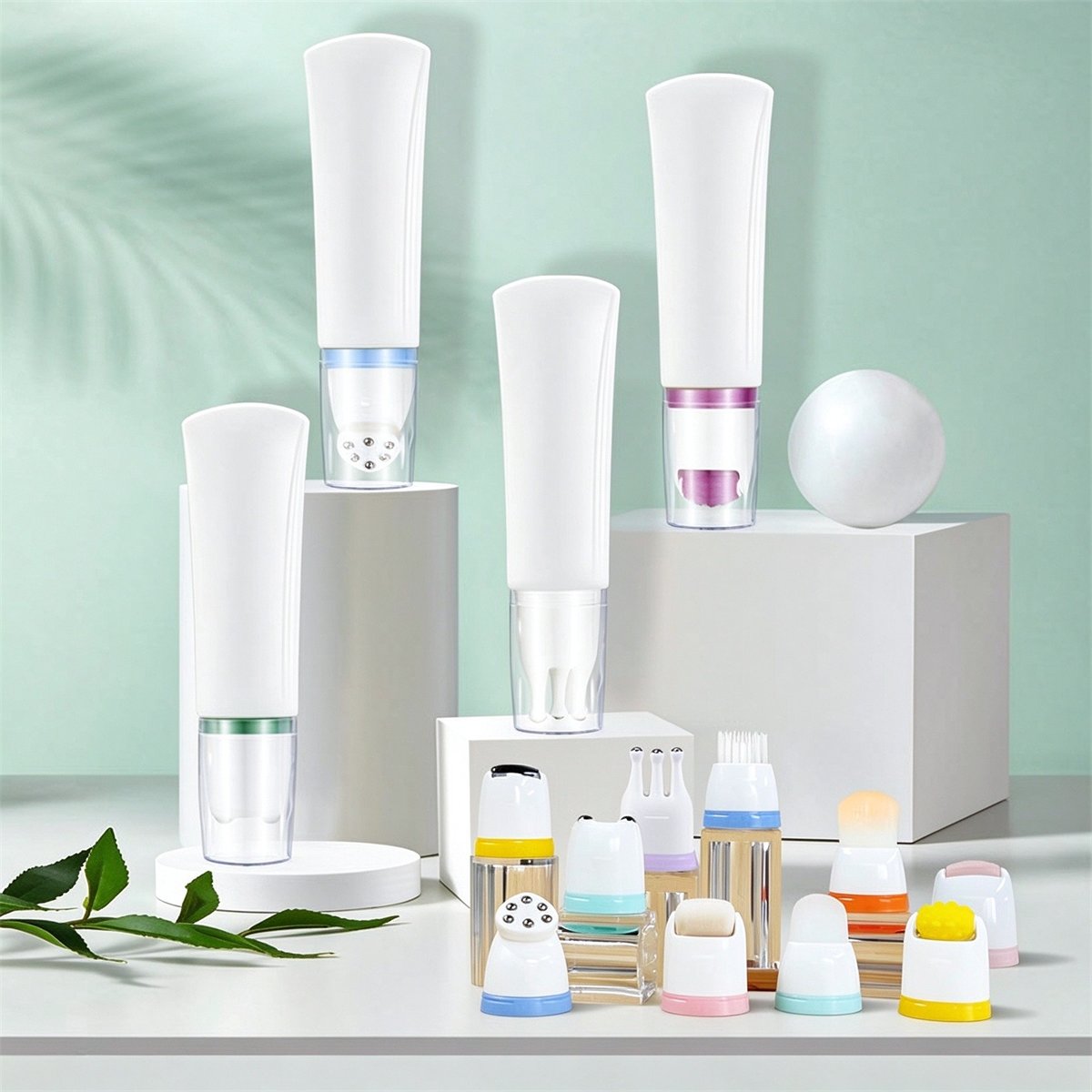
A tube with an applicator is no longer a tube. The head changes the dose, the sensation and sometimes the formulation itself. It is also the part most often specified last, which is why applicator projects run into rework.
Here is how the four common heads behave.
Roller ball
A stainless or glass ball in a PP housing. The ball rotates as it moves over skin and deposits a thin, even film, with a cooling effect that comes from the metal's thermal mass.
Use it for eye serums, caffeine gels, spot treatments and after-bite products. The ball diameter sets the flow: a 25 mm housing with a larger ball delivers more per stroke than a slim 19 mm version.
Watch out for: viscosity. A formula that is too thin runs past the ball and leaks into the cap; too thick and the ball skids without dispensing. Both are solved by testing two ball diameters on your own formula, not on water.
Ceramic
A glazed ceramic tip, usually on a D19 or D22 tube. It stays cooler than plastic for longer than metal does, is chemically inert, and does not develop the metallic taste that some consumers notice with steel.
It suits eye creams, sensitive-area gels and products positioned around "cooling" or "calming". Ceramic is heavier and more expensive than a roller housing, and it is brittle — drop testing matters.
Sponge or cushion
A flocked sponge or a foam cushion head, used for concealers, tinted treatments and scalp applications. It delivers product directly to skin and blends at the same time.
The limitation is hygiene and refill logic: the sponge is not cleanable in the way a metal ball is, so the pack is usually a single-use or short-cycle format. It is also incompatible with low-viscosity formulas, which soak straight through.
Precision nozzle
No head at all: a moulded nozzle with a defined orifice, typically 3–10 mm. It gives the most controlled bead and the lowest unit cost, and it is the right choice for eye creams, spot gels and any product applied with a finger or a separate tool.
Nozzle diameter is the specification that matters. A 4 mm orifice on a D19 tube gives a fine line; a 10 mm orifice on a D35 tube gives a broad ribbon for sunscreen.
What to specify before asking for a quote
- The formula's viscosity and yield point.
- The dose you want per application, in millilitres or grams.
- Whether the pack is single-use, a 30-day course, or a 12-month retail SKU.
- Whether the head must be cleanable or replaceable.
- The tube diameter you can fill on your line.
Answer those and the applicator choice is usually unambiguous. Skip them and the project goes through three sample rounds to discover that a roller ball does not work with a 40,000 cps cream.

Where to go next
The head is usually the cost driver. See the full range of heads at applicator tubes, or compare a single-ball format at a 10 ml roller applicator tube.
Specifying this for a real product? Send the drawing or a reference sample.